
New research review: Vitamin supplements fail to improve cardiovascular outcomes in the general population
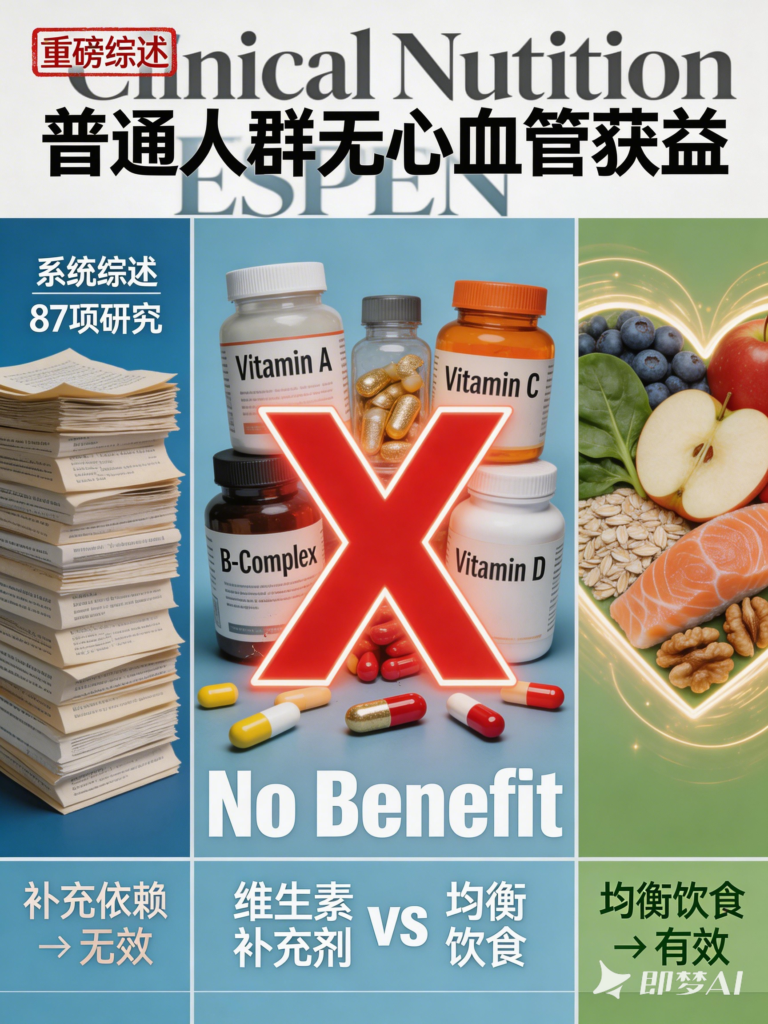
Vitamin supplements have long been promoted as an effective means of maintaining cardiovascular health, especially in the context of increasing global health awareness, and their usage continues to rise. However, a comprehensive review study recently published in Clinical Nutrition ESPEN has raised doubts about this. The research team systematically reviewed 87 relevant studies and concluded that vitamin supplements do not improve clinical cardiovascular outcomes for the general population. It is more reasonable to advocate maintaining a healthy lifestyle through a balanced diet instead of relying on supplements.
Research background: The use of vitamin supplements is becoming increasingly common
In developed countries, cardiovascular disease remains one of the leading causes of death, and the development of preventive medicine has led to a decrease in cardiovascular mortality rates. At the same time, the use of vitamin supplements is becoming increasingly common – in the United States, over 72% of elderly people report using supplements, with vitamins being the primary category. The global dietary supplement market is expected to reach $230.73 billion by 2027.
However, the public’s understanding of supplements often lacks scientific basis, coupled with the psychology of seeking a “panacea”, which further promotes their use. This study aims to review existing evidence and provide reference for clinical practice.
Research method: Focusing on clinical hard endpoints
The research team searched the PubMed database for relevant literature up to October 2020 and ultimately included 87 eligible studies, including 26 randomized controlled trials. The inclusion criteria require that the study must include clinical hard endpoints (such as myocardial infarction, stroke, cardiovascular death, all-cause death, etc.) or key clinical indicators (such as blood pressure, vascular function testing, etc.), excluding studies with a sample size of less than 20 people.
Core finding: Vitamin supplementation has no cardiovascular benefits
Vitamins A, C, E
Early observational studies suggested that vitamin E may be associated with a reduced risk of coronary heart disease. For example, two large cohort studies published in the New England Journal of Medicine in 1993 showed that higher vitamin E intake was associated with a reduced risk of coronary heart disease. However, multiple subsequent randomized controlled trials failed to confirm this association.
A randomized controlled trial involving nearly 40000 healthy women in 2005 showed that vitamin E had no significant effect on myocardial infarction, stroke, cardiovascular death, and overall mortality. Another randomized controlled trial involving over 14000 male doctors in 2008 also found that vitamin E and vitamin C did not reduce the incidence of major cardiovascular events, and vitamin E was associated with an increased risk of hemorrhagic stroke (HR=1.74). In 2004, a study on patients with cardiovascular disease or diabetes even suggested that vitamin E might increase the risk of hospitalization for heart failure.
B vitamins (B6, B9, B12)
Multiple observational studies have shown that high intake of folate and vitamin B6 is associated with a reduced risk of coronary heart disease and stroke. However, a series of large-scale randomized controlled trials have failed to confirm that supplementing B vitamins can translate into clinical benefits.
In 2006, a randomized controlled trial involving 5522 patients with vascular disease or diabetes showed that although the supplement reduced the level of homocysteine, it did not reduce the risk of cardiovascular death and myocardial infarction. Another study in 2010, which included over 12000 patients with myocardial infarction, also showed that supplementation with folic acid and vitamin B12 did not improve the incidence of major coronary events or stroke. A study conducted in 2008 on high-risk women also reached similar conclusions.
Vitamin D
Vitamin D has been a hot research topic in recent years. Early observational studies suggested an association between vitamin D levels and cardiovascular health, but randomized controlled trials also failed to confirm the benefits of supplementation.
A randomized controlled trial involving 5110 participants published in 2017 showed that high doses of vitamin D3 per month (initial 200000 IU, followed by 100000 IU per month) for 3.3 years did not reduce the incidence of cardiovascular disease. A large randomized controlled trial (n=25871) published in the New England Journal of Medicine in 2019 further confirmed that supplementing with 2000 IU of vitamin D3 daily for 5.3 years had no significant effect on major cardiovascular events, stroke, or cardiovascular death. Even in the subgroup with baseline vitamin D deficiency, no benefit was observed.
Compound vitamins and vitamin K
Multiple large-scale studies have also failed to confirm the cardiovascular benefits of multivitamin supplementation. In the 2009 Women’s Health Initiative study, more than 160000 participants were included, and no association was found between multivitamins and cardiovascular disease, myocardial infarction, stroke, or mortality after 8 years of follow-up. A 2019 analysis of over 30000 American adults showed that the use of supplements was not associated with mortality, only the intake of nutrients from food was associated with a lower risk of death.
Regarding vitamin K2, a randomized controlled trial involving 80 patients with vascular disease showed that supplementing with 100 μ g of vitamin K2 daily for 6 months did not significantly improve vascular function.
Potential benefits of special subgroups
It is worth noting that certain special populations may benefit from supplements. For example, a Swedish study showed that supplements were associated with reduced cardiovascular risk only in men who reported inadequate dietary intake at baseline. Another study showed that daily supplementation of 1000-2000 IU of vitamin D3 may have a certain antihypertensive effect on obese children. In addition, individuals with baseline vitamin D levels below 25 ng/mL observed improvement in some vascular function indicators after supplementation.
The research team pointed out that these subgroup analysis results still need further validation, and the vast majority of benefits are limited to those who do indeed have nutritional deficiencies or insufficient dietary intake.
Research Evolution: The Regular Cycle from Observation to Experiment
The research team observed a pattern: early observational studies often found an association between vitamin supplementation and health outcomes, but when randomized controlled trials were conducted, these associations were mostly falsified. This process occurred successively in the fields of vitamins A, C, E (1990s), B vitamins (2000s), and vitamin D (2010s).
The main reason for the difference in results between observational studies and randomized controlled trials is due to confounding factors – supplement users often have healthier lifestyles, such as higher education levels, more regular exercise, and healthier dietary structures. Even with statistical adjustments, it is difficult to completely eliminate the influence of these confounding factors.
Conclusion: A healthy diet is superior to blind supplementation
After synthesizing 87 pieces of research evidence, this study concludes that vitamin supplements cannot improve cardiovascular clinical outcomes for the general population. Early observational studies have shown that the “benefits” are likely due to the confounding factor of a healthy lifestyle, rather than the efficacy of the supplements themselves.
The research team emphasizes that instead of relying on vitamin supplements, it is better to advocate for the public to follow a healthy eating pattern, such as a diet rich in fruits, vegetables, whole grains, beans, nuts, and fish, which is the scientific way to maintain cardiovascular health.
Conclusion
This review provides important references for the application of vitamin supplements in the field of cardiovascular health. It reminds us that nutritional interventions should be based on scientific evidence rather than market promotion. For the general population, a balanced diet is the foundation for maintaining cardiovascular health.
Nugene Pharma Shandong Co., Ltd. is deeply involved in the field of functional raw materials, and its VigouFull ® PQQ、 Vitamin K2, S-adenosyl-L-methionine p-toluenesulfonic acid sulfate (SAM-e), DHA algal oil and other products strictly follow quality standards and are committed to providing high-quality raw material support for people with specific needs. Whether it is daily nutritional supplementation or targeted intervention, science, precision, and safety have always been the core pursuits of Nugene Pharma.