
New research: Dietary supplements may improve emotional symptoms in children with autism
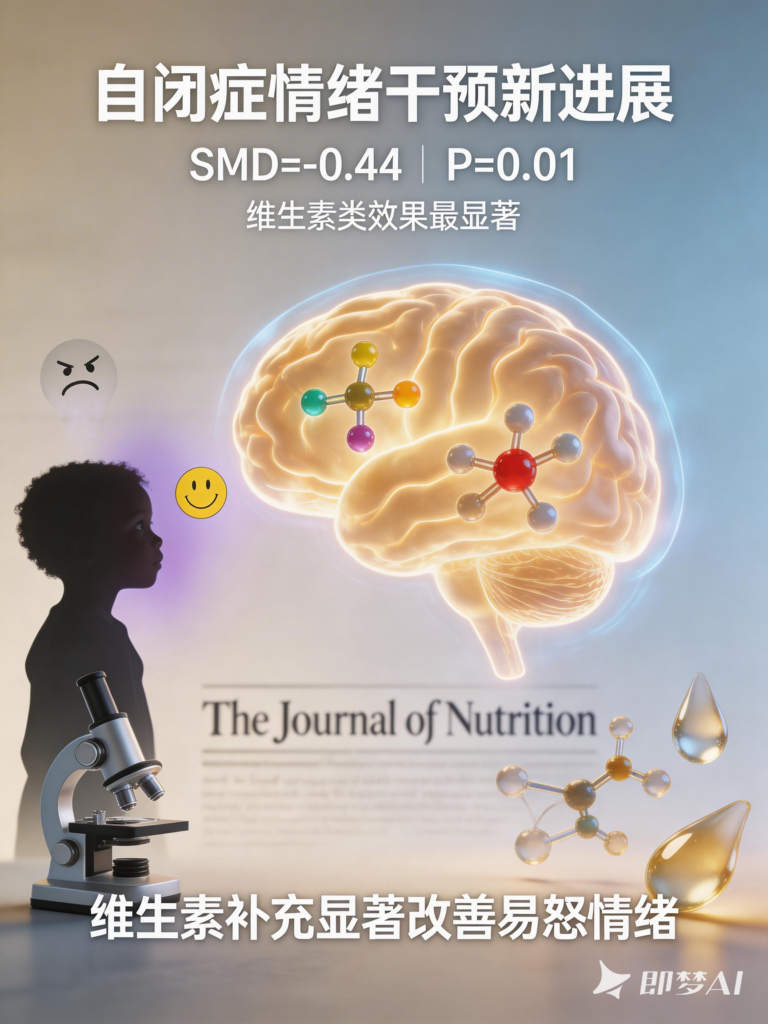
Autism spectrum disorder (ASD) is a neurodevelopmental disorder with a high incidence rate worldwide. In addition to the core symptoms, children are often accompanied by emotional problems such as irritability and anxiety, which seriously affect the quality of life. Recently, a team from the School of Rehabilitation Medicine at Jiamusi University published a systematic review and meta-analysis in The Journal of Nutrition, evaluating the efficacy of dietary supplements in treating emotion related symptoms in children and adolescents with ASD. Research has shown that dietary supplements have a small to moderate significant effect on improving irritability and overall emotional symptoms, with vitamin supplements showing the most outstanding performance.
Research background: Emotional issues have become a new focus of ASD intervention
The global prevalence of ASD is approximately 0.02% to 3.66%. In addition to core symptoms such as social disorders and repetitive stereotyped behaviors, emotional problems such as irritability, anxiety, and depression are extremely common in children with ASD, significantly affecting their quality of life and development trajectory. At present, the US FDA only approves risperidone and aripiprazole for the treatment of ASD related irritability, but these drugs pose risks of metabolic and neurological adverse reactions, and there are no clinically approved drugs for anxiety and other emotional symptoms. Therefore, exploring non pharmacological intervention methods has important clinical significance.
Research Method: Meta analysis of 21 RCTs and 866 pediatric patients
The research team systematically searched PubMed, Cochrane Library, Web of Science, and Embase databases to include 21 randomized controlled trials (a total of 22 studies) published as of May 15, 2025, involving 866 children and adolescents with ASD. The intervention measures include various dietary supplements such as vitamins, unsaturated fatty acids, N-acetylcysteine (NAC), folic acid, probiotics, etc. The main outcome measures were changes in irritability, anxiety, and overall emotional symptoms.
Core finding: Vitamin supplementation has a significant effect
1. Significant improvement in overall emotional symptoms
Meta analysis showed that the dietary supplement intervention group showed significant improvement in emotion related symptoms compared to the control group, with a small to moderate effect size (SMD=-0.34, P<0.001). After excluding studies with high risk of bias, the results remained robust (SMD=-0.31, P=0.04).
2. Significant improvement in irritability
Subgroup analysis of irritable emotions showed that dietary supplements also exhibited small to moderate improvement effects (SMD=-0.36, P=0.02).
3. Vitamin supplements have the best effect
Stratified analysis by supplement type found that the effect of vitamin supplements on improving emotional symptoms was SMD=-0.44 (P=0.01), with the most significant effect. Although folate (SMD=-0.99) has a large effect size, it did not reach statistical significance due to high heterogeneity between studies; Unsaturated fatty acids (SMD=-0.28), NAC (SMD=-0.35), probiotics (SMD=-0.07), etc. did not reach statistical significance levels.
Mechanism exploration: How vitamins improve ASD emotional symptoms
Vitamin D deficiency may be an important risk factor for ASD. Vitamin D regulates the expression of tryptophan hydroxylase 1 and 2 through transcriptional regulation, affecting peripheral and central serotonin synthesis, thereby regulating emotion related symptoms. Vitamin B12 plays a crucial role in neural development and is an important coenzyme for the synthesis of mood regulating neurotransmitters such as dopamine and serotonin. It is essential for maintaining the normal function of mood regulating centers such as the amygdala and prefrontal cortex.
Vitamin deficiency is more common in children with ASD. Supplementing with vitamin D and B12 can help restore neurotransmitter balance and improve emotional problems such as irritability. This is highly consistent with the significant therapeutic effects demonstrated by vitamin supplements in this study.
Unsaturated fatty acids and probiotics: potential to be validated
Unsaturated fatty acids (such as DHA) are key nutrients for brain development, and the levels of DHA and total omega-3 in the plasma of children with ASD are generally low. However, in this meta-analysis, the improvement of emotional symptoms by unsaturated fatty acids did not reach statistical significance (SMD=-0.28, P=0.07). Researchers analyzed that this may be related to differences in dosage, EPA/DHA ratio, baseline levels, and other aspects among studies. Probiotics also did not show significant effects, which may be related to factors such as strain differences, intervention duration, and inconsistent evaluation tools.
Research Implications and Future Directions
This study provides evidence-based medicine for the application of dietary supplements in emotional intervention for ASD. Vitamin supplements, especially vitamin D and B12, have shown good potential in improving irritability in children with ASD, and are safe. Adverse reactions are mostly mild and there is no significant difference compared to the placebo group.
However, existing evidence still has limitations: high heterogeneity between studies (I ²=64.42%), generally small sample sizes, inconsistent intervention doses and durations, and diverse evaluation tools. In the future, larger scale and more rigorous randomized controlled trials are needed to conduct dose exploration studies for a single supplement category, and to explore precise intervention strategies based on baseline nutritional status.
Conclusion
The study by the Jiamusi University team provides new ideas for emotional intervention in children and adolescents with ASD: * * Dietary supplements, especially vitamin supplements, may be a safe and effective auxiliary means to improve irritability * *. In clinical applications, individualized supplementation plans should be developed based on the specific nutritional status of the child.
Nugene Pharma Shandong Co., Ltd VigouFull® PQQ、 Vitamin K2, S-adenosyl-L-methionine p-toluenesulfonic acid sulfate (SAM-e), DHA algae oil and other products are based on science and quality assurance, providing precise nutritional support for various populations including children with ASD. Looking forward to more high-quality research in the future to further clarify the value of different dietary supplements in ASD emotional management.